Wednesday, November 13, 2013

The Bird is the Word

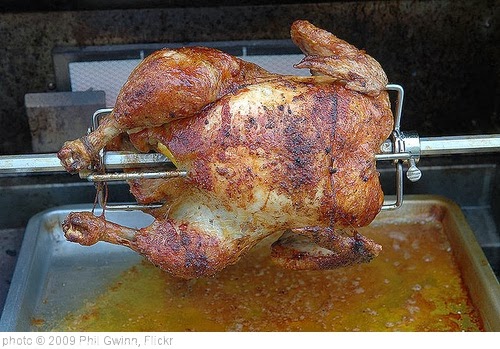
'BBQ Grill Rotisserie Chicken' photo (c) 2009, Phil Gwinn - license: http://creativecommons.org/licenses/by/2.0/


Kim Mappleswitch writes:

At The High Standards Academy of Dramatic Art (HSADA) we're required to teach Standard Stage as a basis for learning IPA. I have asked the faculty here how they teach the /ɜ˞/ sound. On one hand - it's that the tongue tip stays behind the lower teeth and on the other hand it's that the tongue tip is not on the lower teeth, but rather "floats" because the body of the tongue is slightly retracted. What do you guys think? Rhoticity is a difficult topic and I'd like to have some clarity with this symbol and get some other opinions on how to teach it. In the course packet we are supposed to teach out of it says this is a "pure vowel" but I don't see how it can be with an r-hook. This is where I'm hitting a wall with this sound.

(names have been changed to protect the innocent.)

There's much to respond to here. I imagine that Kim is not alone in finding herself in an institution that has yet to join the 21st century as far as speech-training is concerned. But perhaps that's a subject best left for another post. I’m going to tackle the question about physicality first, and leave the transcription question for a bit later.

To be clear, what we're talking about here is the way /r/ is realized after a vowel in rhotic American English, and especially in words like NURSE (the relevant lexical set). Though there is some variation here—some Americans do, in fact, use a strongly retroflexed [ɻ] in words like bird and murder—generally speaking Americans realize post-vocalic /r/ as a 'bunched' /r/, also known as a 'molar' or 'braced' /r/. In Speaking with Skill, Dudley describes it as follows:

Unlike the alveolar /ɹ/ or the retroflex /ɻ/, the tip and blade of the tongue are relaxed down with the tip of the tongue behind the lower teeth and the jaw relaxed open. The middle of the dorsum or body of the tongue is raised and the side edges of the tongue are braced vigorously against the inside of the upper teeth in the area of the rear bicuspids and first molars. Considered in terms of its orientation to the roof of the mouth, this action is taking place in the palato-velar area. The muscular bracing of the tongue has the effect of further tensing and thickening the midline of the tongue, bringing it even closer to the border of the palate and the velum.

JC Catford, in the invaluable A Practical Introduction to Phonetics, describes the same sound as follows:

This vowel was formerly described as ‘retroflexed’ but this is not a correct description. It does not usually have the upward curling of the tongue that is characteristic of retroflexion. Instead, the main body of the tongue is bunched up into a kind of half-close-central position, but with two peculiar modifications: one modification is a moderate degree of deep pharyngalization: the root of the tongue is drawn back into the pharynx just above the larynx. The second modification is a fairly deep depression in the surface of the tongue opposite the uvular zone. This sub-uvular concavity can be acquired as follows. Produce a uvular trill. Note that in order to do this you have to form a longitudinal furrow in the tongue within which the uvula vibrates. Now move the whole body of the tongue slightly forward, while retaining precisely that deeply furrowed configuration. The result should be a close approximation to the typical American ‘bird vowel’, for which the phonetic symbols [ɜ˞] and [ə˞] have been used — both representing a central vowel with an r-like modification.
As we saw, this very strange American vowel involves not only a concavity — or ‘sulcalization’ (from the Latin sulcus `a furrow, or trench') — of the tongue in the neighborhood of the uvula, but also some slight degree of pharyngalization. It is because of this that a series of vowel-sounds with modification of this rhotacized type in some languages spoken in the Caucasus area of Russia, notably Tsakhur and Udi, are known as ‘pharyngalized’ vowels.

The first question is where exactly is the tongue-tip? Is it down, behind the lower front teeth, or does it, in the words of the HSADA instructors, "float"?

The answer is, it depends. Both are possible. It is possible to make a 'molar' /r/ sound with the tongue tip down and out of the action. Only the sides of the tongue come up and make contact with the insides of the upper molars. The jaw must be fairly high (close) for these things to be true simultaneously, of course. You can feel this kind of molar /r/ if you articulate the word green slowly and attentively. Concentrate on keeping the tongue tip down until the final /n/. If you've done this successfully, you've realized the /r/ as a tongue-tip down molar /r/. In actual fact, the tip of the tongue probably does come off the teeth a bit, even if it stays down (it does for me). This is because it is true that the body of the tongue is somewhat retracted for this sound.

(Note that it is not true, pace Catford, that the tongue root must be retracted for a 'molar' /r/. It may well be true that these things often go together—general, blanket tongue-root retraction may be found all over these United States—but it is entirely possible to make a 'molar' /r/ without retracting the root of the tongue.)

Now, it is also possible to make a 'molar' /r/ in a slightly different manner. To really get the sides of the tongue inside the upper molars—enough so that they can actively push out against the teeth, it is necessary to retract the body of the tongue a bit more. The tip will thus come further away from contact with the teeth, and may in fact,"float," in a kind of neither-here-nor-there tongue-tip limbo. Marina Tyndall describes this condition as "Jabba the Hutt tongue," which I think is a very pleasing image. The tip of the tongue is receding into the body—squishing into to as the tongue shortens and gets fatter, just as Jabba the Hutt looks as if he might once have been a tall, cylindrical creature until he was stepped on and squished by some sort of gigantic sand monster. (Which is probably why he's such a sadist, but I'm veering dangerously far afield now.)

If you've tried these two strategies out for yourself—the tongue-tip down 'molar' /r/ and the Jabba the Hutt 'molar' /r/—you may have already observed that they're really just two poles, two endpoints along a single continuum. It would be equally possible to stop anywhere along the way and call that your preferred spot for a 'molar' /r/. Try it out—move smoothly and gradually from one to the other.

In the second configuration (the Jabba the Hutt one), we can vary the bracing action. If we do go ahead and actively push out with the sides of the tongue against the molars, we'll end up with a 'harder' sounding /r/, maybe one reminiscent of Oklahoma or Texas. It's equally possible to do no bracing at all with your Jabba the Hutt tongue, just light contact. So here is another continuum, varying between strong bracing and no bracing. In fact, we can join the ends of these two continua and end up with one continuous continuum, beginning at one end with tongue-tip down 'molar' /r/, moving through light-contact Jabba the Hutt 'molar' /r/, and increasing in bracing until we get to 'hard', strongly-braced Jabba the Hutt 'molar' /r/.


My sense is that when modern Skinnerians ask for 'light' rhoticity (Skinner herself specified that no rhoticity was to be used for singing and “Good Speech in classic texts”), they are asking for the tongue-tip down version. If your goal is to promote a pattern of articulation that leaves the tongue free and ready to go wherever it needs to next, this makes a certain kind of sense. I would argue that the tongue-tip down version is no better in this regard than the light contact version, but both clearly have some articulatory advantages over the strongly braced one, especially if it includes tongue root retraction, as is likely. So to specify the tongue-tip down version is to aim for the end of the continuum that is furthest away from the one that may result in some constriction and less agile articulation.

My position on this is that I feel no need to employ this kind of subtle subterfuge with my students. Not to mince words, there's something almost dishonest, it seems to me, in insisting on a particular articulatory realization as a target merely so as to keep students as far away as possible from a disfavored action. Don't we want our students to have as much fine control and awareness as possible? I certainly do—I want them to have as much understanding of and feel for their own articulators as I can give them. So if the middle point on our continuum, what I'm calling the contact-only Jabba the Hutt tongue, will allow for agile articulation and a free, open vocal tract just as well as the tongue-tip down version, why not teach that? I will admit to some personal bias here—my own NURSE vowel is formed in this way. The tongue-tip down version just doesn’t feel, well, /r/-ish enough to me.

I can point to no instrumental studies on the matter, but I suspect that contact-only Jabba the Hutt tongue is the way the large majority of contemporary Americans realize the NURSE vowel, as well 'consonant' /r/. My students have always felt this to be so as well.

Of course, as with all speech actions, I’d like my students to be able to do all of these things. I don’t mean to prescribe the ‘light contact’ version as the best alternative or the one that should be taught to everybody as the ideal. But if a given student has a strongly braced /r/ with tongue-root retraction, and a freer, more open vocal tract is desired for whatever purpose, the bracing and tongue-root retraction itself are the aspects to address. If the student has an easier time incorporating and owning the ‘light contact’ version, what exactly is the reason for getting them all the way to the tongue-tip down one?

This has turned into an exceedingly long post, so I will save the discussion of symbols for another post.

As always, comments, discussion and vituperative disagreement welcome below.

Tuesday, November 5, 2013

Email address!

'Confusion' photo (c) 2009, Hamner_Fotos - license: http://creativecommons.org/licenses/by/2.0/ We've just established an email address for the blog. You can now write in with questions to:

ktspeechblog@gmail.com


We'd love to hear from you. Any question you may have about transcription, exercises, pedagogy, philosophy, linguistic resources, etc.—send them in!

(The one area I think we can perhaps leave for other forums is requests for help finding resources for specific accents. Those discussions are probably best had on vastavox or the Facebook page. Let's leave this forum specifically for questions to do with Knight-Thompson Speechwork, phonetics, teaching, coaching, linguistics, etc. I think that'll be plenty!)

Bring us your questions!

Tuesday, October 15, 2013

Adding Insult to Investigation

One thing I think we'd like to do with this blog is share ideas for new and fun Omnish exercises. One of us will write a post soon sharing one or two that aren’t in the book. I have also found a need in my teaching, however, for some extra Outlandish exercises. I hesitate to introduce Omnish until my students are thoroughly grounded in the Empty Chart—in all the specific possibilities of obstruent action. But because the Bataan Death March through the Empty Chart can take up to five ninety-minute classes, I have a great need for fun things to do for warm-ups and for quick head and tongue-clearing breaks in the middle of these classes.

One thing I’ve found to be effective and a lot of fun is to have students insult each other in Outlandish. Outlandish, being outlandish, has even more potential for extreme and enthusiastic expression than Omnish does. So it lends itself wonderfully to insults. I generally divide the class into two groups, and send each group to opposite sides of the room. One member of one group walks forward towards the other group and insults them, in Outlandish. The insulted group, as a whole, then responds by repeating, incredulously, the insult or the end of the insult, ideally using a kind of ‘Did he really just say that?’ inflection as they look at each other, full of righteous umbrage. One of them then steps forward and insults the other group generally, hopefully topping the first insult. Lather, rinse, repeat.

Besides being a lot of fun and changing the energy in the room after some very focussed attention on individual specific articulations, this exercise encourages a lot of active muscularity. Whether or not it's pointed out to them after the fact, they get an early chance to start experiencing what it's like to really be physically engaged in the act of speaking. Which is the whole point, after all.

Do you have any fun or creative Outlandish exercises that you do with students?

Monday, September 23, 2013

Narrow transcription


Many, perhaps most people who come and take a Knight-Thompson workshop have already studied phonetics before in some form. Many have also done some phonetic transcription, though for the most part what people have done is quite broad (and even prescriptive in purpose!) and so is more like phonemic transcription than phonetic transcription. And then, of course, there are those who come to the workshops completely fresh, not having studied phonetics before in any form.

Though KTS is much more than just phonetics, of course, narrow, descriptive phonetic transcription is a key element of the work. A high degree of proficiency in it is a requirement for certification. Since opportunites to get feedback on transcription choices are usually pretty limited, we’re going to start occasionally posting short audio files here and asking anyone who wants to do so to post a narrow transcription in the comments. Though the clips will be short, don’t feel like you have to make a full and complete transcription in order to play. If there’s just one word or one little bit that intrigues you, have a go at that and put it up. The hope here is that we can have some rolicking good conversations, and that those who really want to get a better handle on transcription can use this as a forum for practice and learning. It’s very much the intention that this be a group conversation, by the way, not one in which you offer your transcription and we critique it. Engage with each other down below in them thar comments—comment on other people’s transcriptions, ask questions, offer alternatives. You’re a pretty civilized bunch, by and large, so I think we ought to be able to do this in a respectful and supportive way.

I suppose there could be some fear of exposing oneself, so let’s just agree not to judge each other, shall we? I hereby declare this a safe environment (!), all participants are welcome, and no one is going to think less of anyone for offering a transcription that might be off the mark in some respect. After all, if we can’t have a go at things and risk making mistakes, how can we ever learn?

So: here is our first installment. Have at it!


Thursday, September 12, 2013

Complexity nourishes art


I taught my first classes of the new year this week, so I’ve been thinking a lot about Dudley. I miss him tremendously, as so many of us do. But at the same time, I feel incredibly fortunate not just to have known him and learned so much from him, but also to be in a position where I get to continue learning from him by teaching his work.

Phil and I made a fascinating discovery in August, while we were teaching Experiencing Speech in Irvine. It was a small discovery, just a tiny matter of terminology, really, but an affecting one nonetheless. I’ve always preferred the term oral posture over vocal tract posture, even though the latter is obviously a better descriptor for what it is we’re talking about. I often find myself studying accents with interesting and characteristic glottal settings. That sure isn’t the mouth, but it is absolutely an aspect of the thing we’re looking at. (When I’m teaching it, I call it oral posture more often than I call it vocal tract posture, but I make it clear that vocal tract posture is really what we’re talking about.)

I’m not quite sure why I prefer the term oral posture, in spite of its slight incompleteness. I guess it just feels handier and sounds better to me. I hadn’t known this before this August, but apparently Phil and Dudley had different opinions on this. Each of them actually came up with the concept independently, when they were working separately, Dudley at Irvine and Phil in Ohio. When they came back together they realized they’d been working along exactly the same lines. Phil’s term for this idea was oral posture. Dudley preferred vocal tract posture. They continued to disagree about this even after Speaking With Skill was published. (It’s an indication of just how harmonious their partnership was that not only did I have no idea they disagreed about this, I didn’t even realize they had different preferences.)

Now to my discovery. Curious about how the book introduces the concept, I went back to look. In its first mention, the term appears as ‘vocal tract posture.’ Just like that—it’s vocal tract posture, but only the term posture is bolded. The few remaining times the overall concept is referred to, it’s just posture, with no modifier at all. Phil and I were deeply moved to discover this neat solution, so very Dudley in its elegance and subtlety. Yes, it’s vocal tract posture, not oral posture. (It is Dudley’s book, after all!) But based on the initial bolding and subsequent references, it’s really only posture that’s the relevant, ‘official’ term. The ‘vocal tract’ part in the first mention is a mere descriptor, a modifier. Call it whatever kind of posture you will, Dudley seems to be saying, it’s only the posture part that’s important.

He’s still teaching us.

On Tuesday, I had my students read out the ‘Principles, Perhaps’ from the beginning of Speaking With Skill, something I always do at the beginning of the year. It’s a great place to start. They always resonate with me, and make me re-resolve to be a better, humbler, more inquisitive, wiser (and wittier) teacher. There was one that kept ringing in my ears for the rest of the day, though.

This work embraces complexity in its content. Complexity nourishes art. Reduction of the complexity of speech choices reduces the art.

Complexity nourishes art.

One brave student questioned this. He said that in his mind, the best art was always simple. I said that although this could be said to be a matter of taste—some might legitimately prefer Rubens to Rothko—he might have a point. Great acting, I think, is often motivated by simple thoughts, deeply taken in. There’s another way to think about this, though. Rothko had to go through a lot to come to the simplicity of the style we all know him for. The complexity is there, it’s just not on the surface.

I’ve always loved an answer Judi Dench gave once to a question about what acting felt like for her. She told the interviewer that it felt as though she was standing behind a giant computer console filled with dials and levers and knobs and gauges, frantically running around manipulating and monitoring the machinery, now pulling a lever, now pressing a series of buttons, now adjusting a dial. What I find so remarkable about this is that it’s hard to think of a less technical-seeming actor than Judi Dench. Think about it—you simply can’t see the seams when she’s acting, whether on the stage or on camera. I gather this is true even in rehearsal. There are no seams. She’s seamless. And yet all the while, somewhere inside, she’s frantically running around working the machinery!

Complexity nourishes art.

How exciting.

Tuesday, August 13, 2013


Dudley Knight
1939-2013


It seems likely that anyone coming to this blog at this point will have heard of Dudley’s passing. If not, here’s what happened: On June 25th, 2013, walking home from rehearsal, on a beautiful cool night in Irvine, Dudley Knight was struck down by a heart attack. He died soon after without regaining consciousness.  

What we lost on that night is hard to reckon, impossible to quantify, and just plain difficult to think about.  However, as I get more practiced at dodging the most painful pieces of shrapnel, I discover that I’m able to settle into those memories of Dudley that bring me joy. He was a funny, funny man. The funniest, sharpest, driest wit I’ve ever encountered. He was a masterful story teller, an insightful coach, a thoughtful friend…

…and what I’d like --- what I think we might all appreciate, as a salve to our deprived, and grieving hearts – would be to share a few stories. I know I have a collection, and I’m keen to hear yours. It doesn’t matter how short or long the story, whether it’s funny or somber. Let’s just give ourselves the gift of sharing our collection of Dudley moments.
Here’s one for starters:

Dudley taught Speech in a small room in a trailer – a temporary building  long since built over by new structures, and looking out the window, we could see a wide expanse of lawn. One of my classmates had a habit of coming late, and as we saw her strolling slowly across the lawn, apparently unconcerned that she was already 10 minutes late, Dudley seemed to have had enough. He barked out, “Give  me a nonsense word!” like he was calling for more ammunition. Someone offered “schwiznet” /ˈʃwɪznɛt/, and he thanked them and turned back to the lesson. That lesson was on vowel length. When our classmate finally arrived, Dudley welcomed her with a smile and let her know that she had missed the beginning of his lecture on “vowel schwiznet”  but that he would be happy to review.  He proceeded to do just that, talking about the concept of schwiznet,  quizzing us on degrees of schwiznet, asking us about the distinction between a vowel being half, of fully schwizzed. When the tardy student asked about the condition of lack of schwiznet, Dudley replied “If there is no schwiznet, then we would describe the vowel as ‘glit’ /ɡlɪt/. He kept this up through the class, and even through subsequent classes, until I finally broke down and let the cat out of the bag.

That is some dry humor, and perhaps the deep origin of Omnish.

Tell me one of your Dudley stories.

Wednesday, December 12, 2012


SPEAKING WITH SKILL, 2ND EDITION, 1ST DRAFT

Now that Speaking with Skill is readily available worldwide just in time for holiday gift-giving, I could allow a sigh of relief to flow egressively from my alveolar sacs; were it not for the fact that I managed to distribute liberally—throughout its pages—words,  sentences and sometimes entire paragraphs that need to be changed. Others might call these “errors” or “omissions” or “stupidities,” and some reviewer undoubtedly will, but I consider the opportunity to fix them an ongoing retirement “hobby.”

I offer therefore the following four corrections to the text. This is just for starters, mind you. I know that there are some typos, poorly shaped phrases, fuzzily expressed ideas and instances of questionable phonetic transcription in the book. I will let these pass until I actually do the second edition. (Though do But these are four that I am moved to correct right away; and that certainly need to be borne in mind by anyone teaching out of this book. Here they are, in descending order of egregiousness.

  1. Why I got a C in First-Year Greek in college.  This one actually qualifies as stupidity. I have a long, boring and self-serving explanation as to why I came to write the two sentences that I will quote, and I will provide it upon written request, but I will not burden you with it here. I present them are as they appear on page 66, second paragraph, of Speaking with Skill: ‘It comes from the Greek word fdoggoV, meaning “sound”. Oh, by the way, voice the “th”.’ So wrong. Oh, so wrong. What that spelling would come up with, if spoken, would be pronounced approximately as “fdongos,” which is at least only mildly prurient. The correct Greek spelling of the word in question is fqoggoV. It is pronounced with the characteristic “phth” combination that one often finds in Greek. Oh, by the way, you don’t voice the “th”, so the sentence that breezily says oh by the way you do should be eliminated.

  1. The missing approximants. This is a sin of omission. There is one line omitted in the Symbol Practice Exercise on page 143: the Lateral Approximants. Here it is. Place it right between Approximants and Other Symbols:
 l             ɭ             ʎ             ʟ      

  1. Three lost paragraphs found.  On page 208, while discussing the disadvantages of the “vowel substitution” method for transcriptions of accent differences, I say grandly “But first we must examine. . .” allowing the ellipsis to build suspense all the way to the very next line that starts with the heading The Territory. The territory in the book, though, is a bit cramped, because I left out three paragraphs that actually explain what is going on. Here is the entire text that would continue onto page 209:

“The Territory. When we look at a vowel quadrilateral, divided into sections by lines and populated by symbols in suspiciously orderly array, we may get a hint that we are looking at a theoretical construct. And so we are. When famed British phonetician Daniel Jones established this version of a vowel chart (modifying earlier variants) in 1917, he did so by placing most of the front and back vowels in equidistant intervals from close to open. The few remaining vowel phonemes are also placed with some symmetry in between these so-called cardinal vowels. Jones constructed this formal graph to define the physical territory of the vowel chart, limited to its quadrilateral shape by the limits of vowel articulation within the oral cavity. By so doing, he was able to define physically the territory within the chart by providing specific points of physical reference, all related to degree of tongue arching/cupping or lip rounding/unrounding, the two chief ways of shaping acoustically the unobstructed flow to form vowels. He did not place the cardinal vowels in these positions because he was in any way suggesting that words using these phonemes must be pronounced at the cardinal positions.

“Physically you could enact the voiced, unobstructed flow anywhere within the limits of the vowel quadrilateral, including—but not limited to—the places where the cardinal vowels sit in isolated splendor.  What’s more, if we lump together all the world’s individual speakers’ patterns in all accents in all languages, every possible physical and acoustic exploration of the quadrilateral will happen. There are innumerable gradations of action and sound.

“Each vowel phoneme carries with it a unit of meaning that differentiates it from the other vowel phonemes and as long as we keep their realizations as sounds within that stern “cardinal” separation that Jones created, the “territory” is an easy one to navigate and there is no question about what phoneme you are saying. But in practice—and Jones knew this—each vowel phoneme exists within what I like to call its phoneme cloud that contains all the discrete possibilities for pronunciation variation that still convey the vowel phoneme’s unique meaning. Within the territory of the vowel quadrilateral there are (depending on what language you are speaking) a lot of phoneme clouds, each with its own wispy territory and its own shifting boundaries. On a clear day, the phoneme clouds remain separate or butt gently against one another. Sometimes, in cases of inclement linguistic weather, these clouds intersect and even flow into the territory of one another; these blended areas are where transcriptions that depend on vowel substitutions may be convenient; but they can also get you into real trouble, because if you don’t have a larger context within a sentence to define meaning your listener may not know what you’re saying. You may pronounce “sheep” like “ship”, or “ship” like “sheep”, for example; so if you write a purchase order that says “I want to buy a sheep” and phonetically transcribe (What purchase order is not written phonetically these days?) the last word as [ʃɪp] just because in your own pronunciation the phoneme cloud for [ʃip] has strayed southward, you may be surprised at what is delivered to your farm.

“The further a phoneme cloud gets into the territory of another phoneme cloud, the more the resilience of meaning relies on these larger linguistic structures – grammar, other words in the sentence, tone of voice, emphasis, voice quality, intonation, and so on. For all these reasons, vowel substitutions are a limited way to show the phonetic variation that we find in accents. They are convenient, though.”

  1. Pronunciation Exercise Phonetics Revised.   Pages 314 – 315. I have revised the phonetic transcription for this passage, cleaning up some errors and inconsistencies. I hope you don't have to squint too much at the font size.

If you are using Speaking with Skill as a text in your classes, I hope you will take these corrections to heart.  Especially that "phthong" spelling in Greek.